Table of Contents
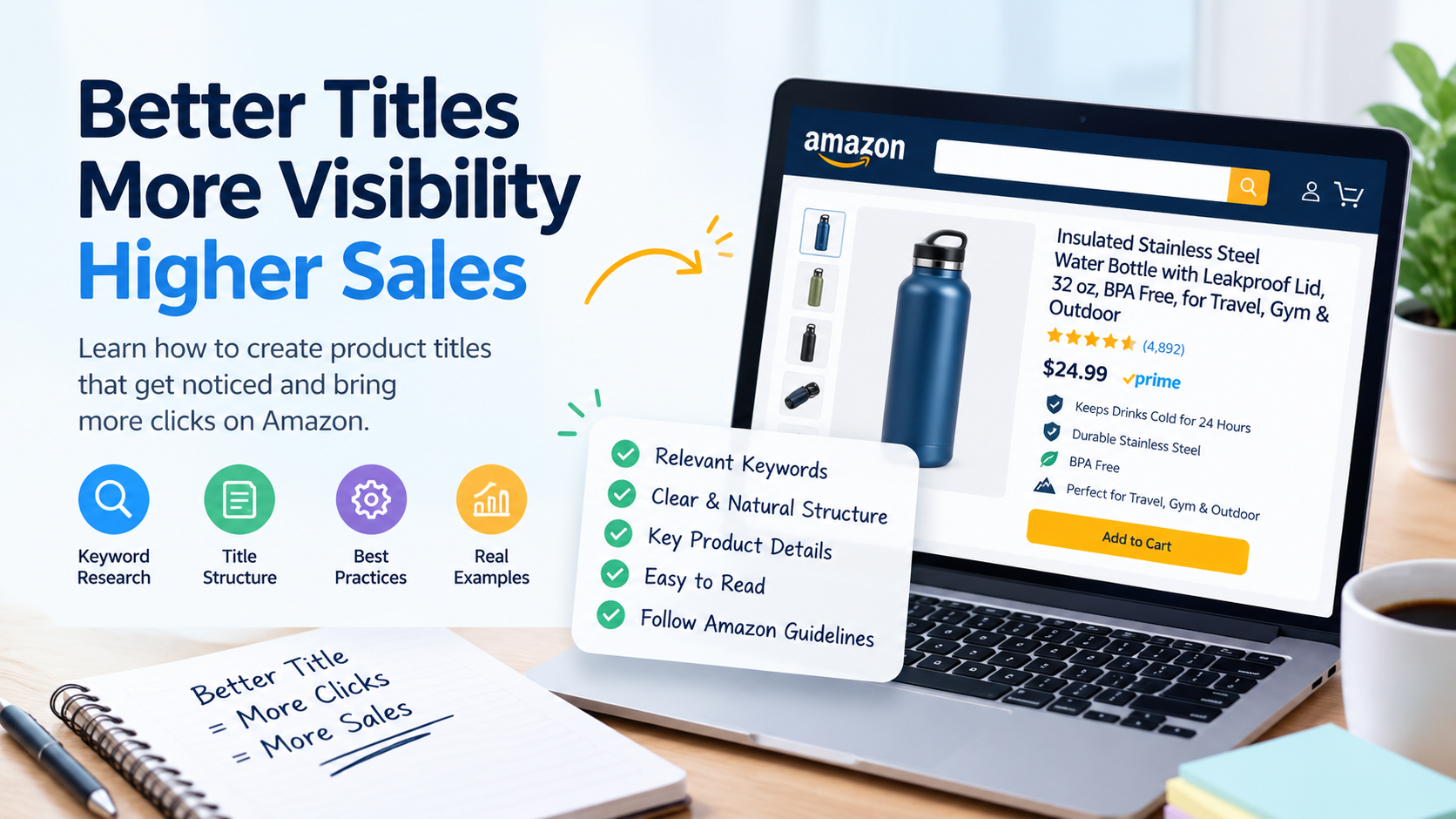
Your Amazon product title is one of the first things shoppers see when they come across your product in search results. A clear, informative title can help shoppers quickly understand what you’re selling and whether it matches what they’re looking for.
That’s why Amazon product title optimization is an important part of creating an effective product listing. The goal isn’t to fill the title with as many keywords as possible. Instead, you want to combine relevant search terms with important product information while keeping the title easy to read.
A well-structured title should communicate the product clearly, highlight important details, and follow Amazon’s current title requirements for the relevant category.
In this guide, you’ll learn how to optimize an Amazon product title, what information to include, common mistakes to avoid, and how AI tools can help you create and improve title variations.
What Is Amazon Product Title Optimization?
Amazon product title optimization means improving your product title so it clearly communicates what the product is while naturally including relevant search terms.
A well-optimized title should help both Amazon shoppers and search systems understand the product. It should provide the most important information without becoming difficult to read or overloaded with keywords.
The main goal is to balance search relevance, product information, readability, and Amazon’s current requirements for the relevant category.
Why Does Amazon Product Title Optimization Matter?
Your product title is one of the first pieces of information shoppers see when browsing Amazon search results or product pages. A clear title can help shoppers quickly understand whether the product matches their needs.
Title optimization can also support:
- Better visibility for relevant searches
- Clearer communication of product details
- Improved click-through potential
- Better shopper understanding before opening the listing
- A more consistent and professional product listing
However, optimization should not mean adding every possible keyword. Relevant terms should be used naturally while keeping the title useful for real shoppers.
What Should an Amazon Product Title Include?
The exact information needed can vary depending on the product category and Amazon’s requirements. However, a useful product title generally focuses on the details that help shoppers identify and understand the product.
1. Brand Name
Include the brand when it is relevant and appropriate for the listing.
Example:
NutriHome Stainless Steel Water Bottle…
2. Product Type
Clearly state what the product actually is.
Example:
Stainless Steel Water Bottle
3. Primary Product Keyword
Use the main search term that accurately describes the product.
For example, if shoppers commonly search for a stainless steel water bottle, that phrase can be incorporated naturally rather than repeating similar keywords multiple times.
4. Key Features
Add important characteristics that help differentiate the product, such as:
- Material
- Design
- Size
- Capacity
- Compatibility
- Important functionality
5. Size or Quantity
Where relevant, include information such as:
- 32 oz
- Large
- 2-Pack
- 500 ml
6. Color or Variation
Include color, size, or other variation information when it is useful and appropriate for the specific listing.
The exact combination of these elements should depend on the product category rather than following one universal title formula. You can review Amazon’s product detail page guidelines to understand the information Amazon expects for product listings.
How to Optimize an Amazon Product Title
1. Research Relevant Amazon Keywords
Start by identifying the search terms that are genuinely relevant to your product.
Focus on:
- Primary product keywords
- Specific product terms
- Important features
- Product attributes
- Relevant long-tail keywords
The objective is not to collect as many keywords as possible. Instead, identify the terms that accurately describe what shoppers are searching for and can naturally fit into your title.
2. Identify the Most Important Product Information
Before writing the title, determine which product details shoppers need to know first.
For example, for a wireless keyboard, important information could include:
Brand + Product Type + Compatibility + Key Feature + Connection Type
This gives you a basic structure to work from before adding keywords.
3. Put the Primary Product Term Naturally in the Title
Your main product term should appear naturally where it makes sense.
Weak:
Keyboard Wireless Keyboard Computer Keyboard Bluetooth Keyboard
Better:
Logitech Wireless Keyboard, Bluetooth Keyboard for Windows and Mac
The second example communicates the product clearly without repeatedly using the same keyword.
4. Follow Amazon’s Current Title Requirements
Amazon has specific requirements that can vary by category and can change over time. Before publishing or updating your product title, check Amazon’s product title requirements for the latest rules applicable to your category.
Do not rely on a fixed character limit or an old optimization rule without checking the latest requirements. Competitor guides currently give different limits, which is another reason to verify the applicable Amazon guidance directly.
5. Structure the Title for Easy Scanning
Even when a title contains the right keywords and product details, it should still be easy to understand at a glance. Avoid putting too many details together in a way that makes the title difficult to read.
A practical structure you can use is:
Brand + Product Type + Primary Feature/Keyword + Important Attribute + Size/Quantity + Use Case
For example:
Brand: HomePro
Product Type: Stainless Steel Water Bottle
Feature: Insulated
Capacity: 32 oz
Use Case: For Travel
This could become:
HomePro Stainless Steel Water Bottle, Insulated 32 oz, Reusable Bottle for Travel.
This is a practical writing framework, not a universal Amazon-required formula. The exact order should be adjusted according to the product and category.
6. Highlight Important Features and Attributes
Use the title to communicate the product details that are most useful for shoppers.
Depending on the product, these may include:
- Material
- Size or capacity
- Color
- Quantity
- Compatibility
- Model
- Main functionality
- Intended use
For example:
Weak:
Wireless Headphones
Better:
SoundMax Wireless Headphones, Bluetooth Over-Ear Headphones, Noise Cancelling, 40-Hour Battery
The second title gives shoppers more useful information without relying on unnecessary keyword repetition.
7. Write for Shoppers, Not Just Search
Amazon SEO is important, but your title should still sound natural to a person reading it.
Avoid writing titles that look like a collection of search queries:
Poor:
Women Shoes Running Shoes Women Sneakers Running Shoes Lightweight Shoes
Instead, communicate the product naturally:
Better:
Women’s Lightweight Running Shoes, Breathable Athletic Sneakers for Daily Training
A readable title makes it easier for shoppers to understand the product and its main characteristics. Competitor guidance also emphasizes clarity, readability, and avoiding keyword stuffing as important parts of title optimization.
8. Remove Keyword Stuffing and Promotional Language
Adding the same keyword repeatedly does not make a title better. It can make the listing look unnatural and harder to read.
Avoid:
- Repeating the same keyword multiple times
- Unnecessary promotional claims
- Excessive symbols
- Pricing or discount information
- Information that does not help identify the product
Instead, use your most relevant terms once where they fit naturally and use the remaining space for useful product information.
For example:
Keyword-stuffed:
Coffee Mug Coffee Cup Ceramic Coffee Mug Coffee Cup for Coffee Tea Mug
Improved:
Ceramic Coffee Mug, 12 oz Coffee Cup for Home and Office, Dishwasher Safe
The second version gives shoppers meaningful information while keeping the wording natural. Amazon-focused competitor guidance also highlights avoiding redundant words, promotional phrases, and unnecessary symbols.
9. Check Your Title Against Competitors
Before finalizing your Amazon product title, review titles from competing products in the same category. This can help you understand how successful listings present important product information.
Look for:
- Common product terms
- Important features competitors mention
- Product attributes shoppers may expect
- How titles are structured
- Information that appears repeatedly across relevant listings
However, don’t simply copy a competitor’s title. Use competitor research to identify useful patterns and then create a title that accurately represents your own product.
10. Test and Review Your Title Over Time
Amazon product title optimization doesn’t necessarily end after publishing the listing. You can review your title’s performance and make changes when there is a clear reason to do so.
Consider reviewing your title when:
- Your product receives new search data.
- You discover more relevant keywords.
- Your product or packaging changes
- Amazon updates its listing requirements.
- Competitor listings change significantly.
- Your title is not clearly communicating the product.
Some Amazon optimization guides also recommend testing different title approaches and regularly reviewing listings rather than treating optimization as a one-time task. Your title is only one part of Amazon keyword optimization. For search terms that don’t fit naturally into the visible title and listing copy, learn more about Amazon backend keywords
Amazon Product Title Examples
Seeing the difference between a weak and improved title can make title optimization easier to understand.
Example 1: Electronics
Weak:
Bluetooth Headphones Wireless Headphones Headset
Better:
SoundMax Wireless Bluetooth Headphones, Over-Ear Headset with Noise Cancellation, 40-Hour Battery
Why it’s better:
It identifies the brand, product type, key feature, and an important product benefit without repeating the same keyword.
Example 2: Kitchen
Weak:
Water Bottle Bottle Stainless Steel Water Bottle
Better:
HomePro Stainless Steel Water Bottle, Insulated 32 oz, Leakproof Reusable Bottle for Travel.
Why it’s better:
The improved title provides the material, capacity, key feature, and use case in a natural structure.
Example 3: Clothing
Weak:
Women’s Shirt Women’s Shirt Casual Shirt Top
Better:
Women’s Casual Cotton T-Shirt, Short Sleeve Crew Neck Top for Everyday Wear
Why it’s better:
It clearly communicates the product type, material, style, and intended use without unnecessary repetition.
Example 4: Beauty
Weak:
Face Moisturizer Moisturizer Facial Cream Skin Cream
Better:
Hydrating Face Moisturizer, Lightweight Daily Facial Cream for Dry Skin, Fragrance-Free
Why it’s better:
The title focuses on the product, its main characteristic, and relevant use case instead of repeating similar keywords.
Common Amazon Product Title Mistakes
Even when a title contains relevant keywords, small mistakes can make it less useful for shoppers. Avoid these common problems when optimizing your Amazon product titles.
1. Keyword Stuffing
Adding the same keyword repeatedly makes the title look unnatural and can reduce readability.
Avoid:
Running Shoes, Running Sneakers, Running Shoes for Men, Running Shoe
Better:
Men’s Lightweight Running Shoes, Breathable Sneakers for Daily Training
2. Repeating the Same Information
Don’t use multiple phrases that communicate the same product detail.
For example, using Wireless Bluetooth Headphones followed by Bluetooth Wireless Headset adds little useful information.
Instead, use that space for important details such as compatibility, battery life, size, or another relevant feature.
3. Using Promotional Language
Avoid turning the product title into an advertisement with unnecessary promotional wording.
Examples include phrases such as:
- Best Seller
- Amazing Product
- Limited Time Offer
- Buy Now
- Free Shipping
Competitor guidance specifically highlights promotional phrases and unnecessary wording as things to avoid in optimized titles.
4. Using Unnecessary Symbols
Excessive punctuation or decorative symbols can make a title harder to read. Keep the title clean and follow the formatting requirements applicable to your Amazon category.
5. Leaving Out Important Product Information
A title should give shoppers enough information to understand what they are looking at.
Depending on the product, missing information could include:
- Size
- Quantity
- Color
- Material
- Compatibility
- Model
- Main feature
6. Ignoring Amazon’s Current Requirements
Amazon’s title requirements can change and may differ by category. Don’t rely on outdated articles or a fixed character limit without checking the latest Amazon listing requirements for your marketplace and product category.
How AI Can Help With Amazon Product Title Optimization
AI can make the title optimization process faster, especially when you need to create multiple title variations or review existing listings.
Generate Title Ideas
Give an AI tool your product information, target keywords, features, and audience. It can generate several title variations that you can review and refine.
Incorporate Relevant Keywords
AI can help identify natural places to include your primary and secondary keywords without unnecessarily repeating them.
Improve Readability
If an existing title is too long, repetitive, or difficult to understand, AI can help rewrite it into a clearer structure while keeping important product information.
Create Multiple Variations
You can generate different versions of a title and compare their:
- Keyword usage
- Clarity
- Product information
- Readability
- Overall structure
Review an Existing Title
AI can also be used as a second check. Give it your current title and ask it to identify:
- Missing important information
- Keyword repetition
- Unclear wording
- Unnecessary phrases
- Potential formatting issues
However, AI-generated titles should always be reviewed against the actual product information and Amazon’s current requirements before publishing.
Amazon Product Title Optimization Checklist
Before publishing or updating an Amazon product title, use this checklist to make sure the title is clear, relevant, and properly structured.
Keyword Checklist
- Primary product keyword is included naturally.
- Relevant secondary terms are used where appropriate.
- Keywords accurately describe the product.
- No unnecessary keyword repetition
- No keyword stuffing
Product Information Checklist
- Brand name is included where appropriate.
- Product type is clear.
- Important features are mentioned.
- Relevant size, quantity, or color is included.
- Compatibility or model information is included when necessary.
- Important product attributes are not missing.
Readability Checklist
- Title is easy to understand
- Information follows a logical structure.
- Wording sounds natural
- Unnecessary words have been removed.
- Title is useful to shoppers, not just search engines.
Compliance Checklist
- Current Amazon title requirements have been checked.
- Promotional language has been removed.
- Unnecessary symbols have been avoided.
- Title does not contain misleading information.
- Category-specific requirements have been considered.
Final Review
Read the title as if you were a customer seeing it in Amazon search results. Ask yourself:
“Can I understand exactly what this product is and what makes it relevant to me within a few seconds?”
If the answer is yes, the title is much closer to being useful for both shoppers and search visibility. Amazon-focused guidance also emphasizes combining relevant keywords with clear, readable product information rather than simply filling the title with keywords.
FAQs About Amazon Product Title Optimization
How do I optimize my Amazon product title?
Start with relevant keyword research, identify the most important product information, and structure the title around the product type, key attributes, and relevant search terms. Keep the wording natural and check Amazon’s current requirements for your category.
What should an Amazon product title include?
Depending on the product and category, a title may include the brand, product type, primary product term, key features, size, quantity, color, compatibility, or other important attributes.
How do I use keywords in an Amazon title?
Use relevant keywords naturally where they accurately describe the product. Avoid repeating the same keyword unnecessarily or adding unrelated search terms to increase keyword coverage.
How long should an Amazon product title be?
There isn’t one universal length that should be applied to every Amazon product. Requirements can vary by category and may change over time, so check Amazon’s current requirements for the specific marketplace and category before publishing.
Can AI write Amazon product titles?
Yes. AI can help generate title ideas, incorporate relevant keywords, improve readability, and create different variations. However, every AI-generated title should be manually reviewed for accuracy and compliance before publishing.
How often should I update my Amazon product title?
Review your title when you have new keyword insights, important product changes, performance data, or updated Amazon requirements. Avoid making changes without a clear reason.
Conclusion
Amazon product title optimization is about finding the right balance between search relevance, useful product information, readability, and Amazon’s current requirements.
Instead of filling your title with keywords, focus on clearly communicating what the product is and why it is relevant to the shopper. Use important search terms naturally, include meaningful product attributes, and remove unnecessary or repetitive wording.
A strong title should be easy to scan, accurately represent the product, and support the overall quality of your Amazon listing.
If you regularly review your keywords, competitor listings, product information, and Amazon’s latest requirements, you can continue improving your titles over time. AI tools can also make this process faster by helping you generate, review, and refine title variations.
For sellers who want to streamline this process, Listomize’s AI Product Title Generator can help create optimized title ideas based on your product information and target keywords.